
“I had a vision for what I wanted to have, but not for who I wanted to become. I thought what I had, would create who I was.”
“I had a vision for what I wanted to have, but not for who I wanted to become. I thought what I had, would create who I was.”
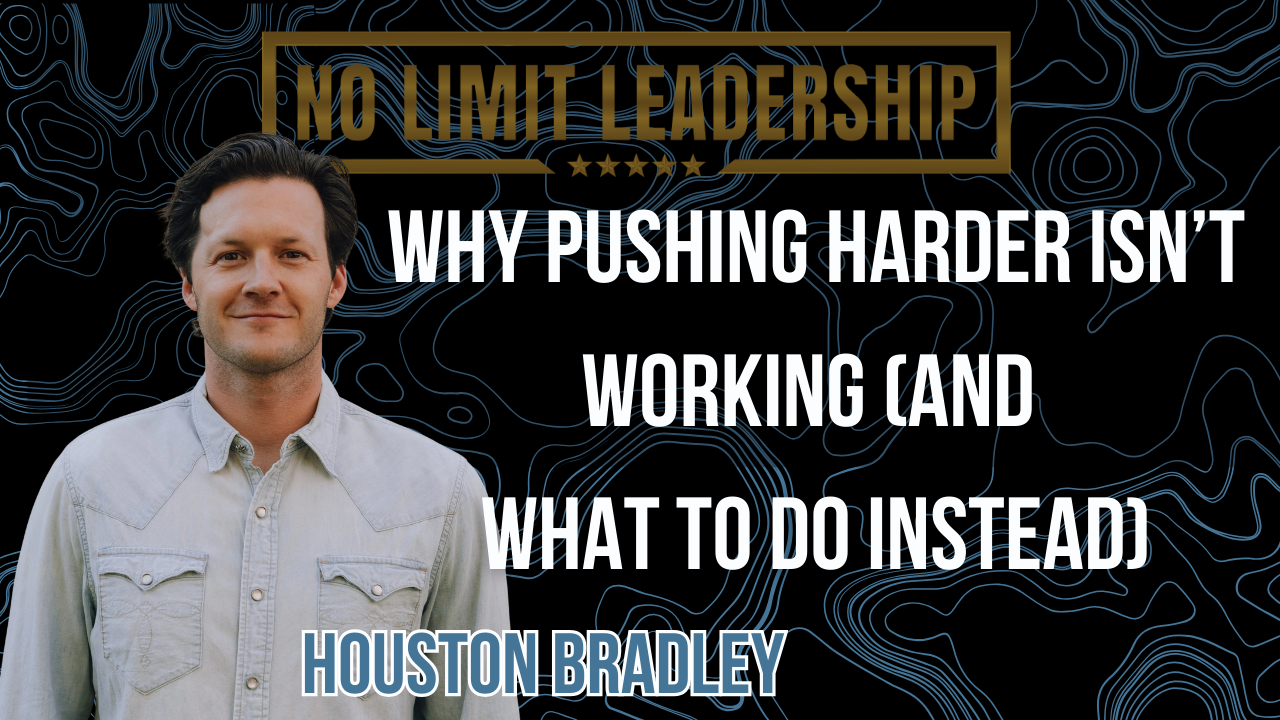
Houston Bradley
A conversation on control, humility, and becoming the leader your future requires.
Most leaders pride themselves on being in control.
-Control got you through hard seasons.
-Control helped you grind, push, and survive.
-Control probably played a role in your success.
But what if the very thing that once saved you is now limiting you?
In this week's episode of the No Limit Leadership Podcast, I sat down with executive coach Houston Bradley for one of the most honest conversations we’ve had on the show. We explored identity, addiction, ambition, ego, humility, and the quiet ways high performers sabotage themselves without realizing it.
Houston’s story begins with a life-threatening brain injury at 17, continues through success in Hollywood, and ultimately lands in recovery, transformation, and purpose-driven leadership. But the real lesson isn’t about addiction or trauma.
It’s about when control serves you and when it silently becomes the problem.
Check out the whole episode:
#110: Why Pushing Harder Isn’t Working (And What to Do Instead) w/ Houston Bradley
Lead Yourself
The need to be in control often starts as a strength.
-It helps you push through uncertainty.
-It keeps you moving when others freeze.
-It gives you something solid to hold onto when the path isn’t clear.
But when control becomes a way of being rather than a situational tool, it carries a hidden cost.
Clinging to control narrows your vision. When you are head-down grinding, rowing, and pushing under constant strain, your mind closes to alternatives you can’t see from inside the effort. You become so focused on forcing outcomes that curiosity disappears. Possibilities shrink. Options you might otherwise consider never even enter the conversation.
Over time, this way of operating becomes exhausting.
Constant pushing drains energy rather than creating momentum. It limits creativity, reduces adaptability, and quietly erodes the very effectiveness it once produced. What helped you survive a season can eventually trap you inside it.
Self-leadership requires knowing when effort is serving growth and when it is preventing it.
Action Steps:
Notice where you’re forcing outcomes. Identify one area of your life or leadership where you’re trying to control results instead of exploring alternatives.
Lift your head up. Ask yourself what opportunities, perspectives, or feedback you might be missing because you’re focused solely on execution.
Experiment with release. Choose one situation this week where you intentionally loosen control and observe what new options or insights emerge.
Lead Others
One of the most dangerous side effects of chronic control is how quietly it erodes trust.
When leaders cling to control, they often believe they are protecting the team, maintaining standards, or keeping things from falling apart. But over time, that posture sends an unintended signal, don't stop to question, just do. Initiative slows. Creativity shrinks. People begin to wait rather than step forward.
Houston shared how, during his years of outward success, he unintentionally surrounded himself with people who wouldn’t challenge him. Not because he feared feedback, but because independence felt like freedom. In reality, it removed the very friction that creates growth.
True leadership requires a shift from control to shared responsibility.
Teams grow when leaders create space for challenge, invite dissent, and model humility in real time. When leaders slow down enough to listen and reflect, they uncover blind spots, surface better ideas, and allow others to take ownership of outcomes.
Action Steps:
Invite challenge intentionally. In your next decision, ask your team, “What am I missing?” and resist the urge to defend your initial position.
Watch where control concentrates. Notice where decisions or problem-solving consistently funnel back to you and ask what would need to change for others to own them.
Model learning publicly. Share a moment where feedback changed your thinking to reinforce that growth, not control, is the expectation.
Becoming a No Limit Leader
Control can get you through a season.
But when it becomes your default, it limits your potential.
Many leaders don’t stall because they lack effort or discipline. They stall because they keep leading from survival long after the threat has passed. What once helped them push through adversity becomes the lens through which they see every challenge.
When control becomes the default, energy drains instead of multiplies. Vision narrows. Curiosity fades. Leaders stay in motion but stop progressing. Over time, effort replaces effectiveness and busyness disguises stagnation.
No Limit Leaders recognize this moment for what it is. Not a signal to push harder, but a signal to lead differently.
Growth requires awareness. It requires trust. It requires the courage to loosen control and allow new possibilities to emerge.
Leadership is not about forcing outcomes.
It’s about becoming someone capable of creating better ones.
And that shift begins the moment you stop operating with a survival response and start leading with humble confidence.
"Challenge Limits. Develop Leaders. Fuel Greatness."
-Sean Patton
Novus Global Executive Coach | Keynote Speaker | Host of the No Limit Leadership Podcast
Subscribe & Listen to latest podcast episode: Apple - Spotify - YouTube
Email me directly to inquire about coaching or speaking at SeanPatton@novus.global
“How you do anything is how you do everything.”
“How you do anything is how you do everything.”
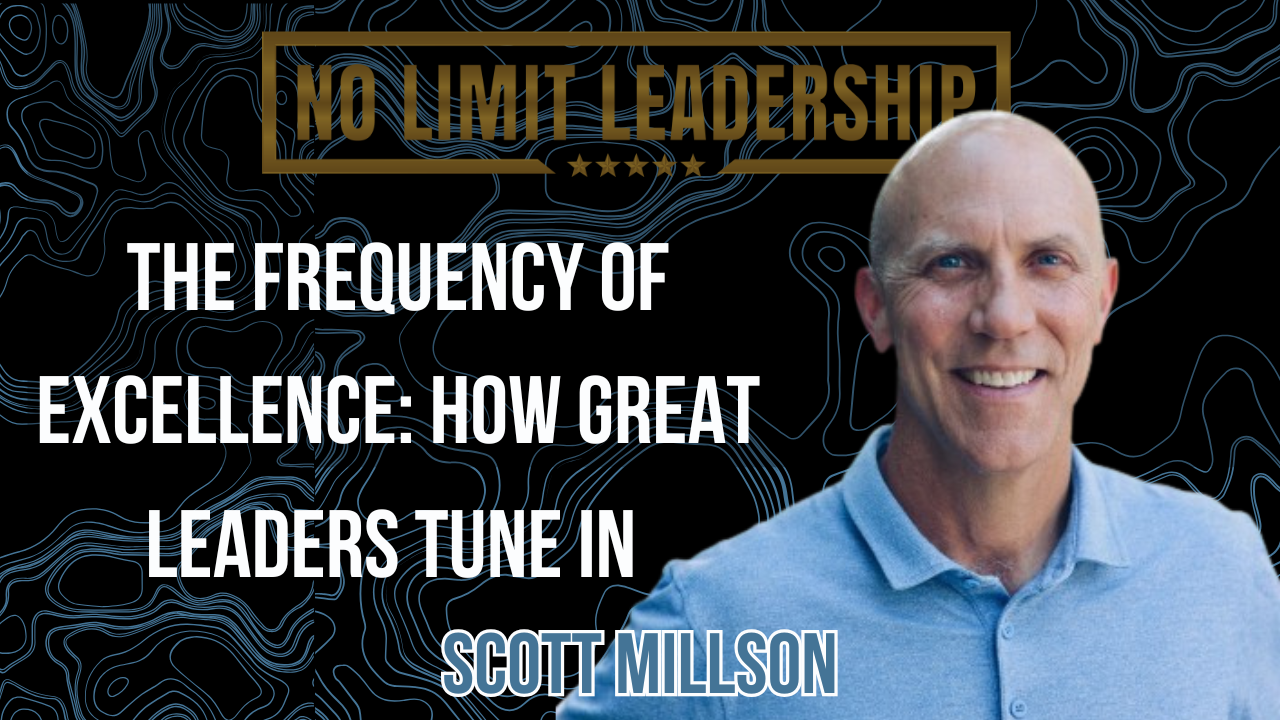
Scott Millson
Most leadership breakdowns don’t happen in moments of crisis.
They happen in moments of distraction.
In this week’s No Limit Leadership podcast, I sat down with Scott Millson, former U.S. Navy petty officer, executive, and author of Frequency of Excellence. What emerged was a powerful reminder that leadership excellence is not about intensity, charisma, or always having the answer. It is about presence, humility, and the ability to slow down long enough to notice what actually matters.
Scott shared a simple story from Navy boot camp. Recruits were taught to fold their underwear to within an eighth of an inch. Annoyed, Scott asked his commanding officer why it mattered. The response changed his life.
“How you do anything is how you do everything.”
That lesson was not about underwear. It was about standards, attention, and responsibility for the lives entrusted to you. It was also about something many leaders struggle with today: being fully present.
Check out the whole episode:
#109: The Frequency of Excellence: How Great Leaders Tune In w/ Scott Millson
Lead Yourself
Most leaders don’t struggle because they lack capability. They struggle because they are constantly reacting.
Scott introduced a demanding but clarifying idea. Excellence is always available, but only if you are tuned in. Leaders miss critical lessons not because they are incapable, but because they are distracted.
Leading yourself starts with presence. That means resisting the urge to rush, perform, or prove yourself. It means choosing curiosity over ego and reflection over speed. Scott shared how adopting a growth mindset became his anchor. He never needed to be the smartest person in the room, but he committed to outlearning and outlistening through attention and reflection.
He also emphasized the power of the pause. When you witness something done well or poorly, stop. Capture the lesson. Write it down. Say it out loud. If you do not pause to reflect, the lesson never makes it from short-term awareness into long-term wisdom.
Action Steps:
Ask yourself once a day, “What did I notice today that I would have missed last year?”
Create a simple system to capture lessons. Notes app, notebook, or voice memo.
Replace the urge to react with a deliberate pause before responding.
Lead Others
The fastest way to lose trust is to believe leadership means having all the answers.
One of the strongest themes of the episode was humility. Scott shared that the best leaders he has ever worked with were not the loudest or most certain. They were the most curious.
He told the story of Captain Mike Abrashoff, who took command of the lowest-performing ship in the U.S. Navy. Instead of asserting authority, Abrashoff invited every sailor into his quarters and asked one question: “What would you do if you were in my position?”
That single act of humility unlocked insight the command team never could have generated alone. Within a year, the ship became the highest-performing in the Navy.
Leadership is not about guarding influence. It is about giving it away. Trust and respect must flow down before they ever come back up. When leaders listen, act on feedback, and model learning, people stop complying and start owning.
Scott put it simply. The words “I don’t know” are not weakness. They are an invitation to step into leadership.
Action Steps:
Ask your team one question this week and listen without defending: “What’s getting in the way of doing great work?”
Publicly share something you are learning as a leader.
Act on one piece of feedback quickly to close the trust loop.
Becoming a No Limit Leader
Leadership is not a role you perform. It is a standard you live.
When you choose to see yourself as a leader, you start holding yourself to a higher way of being. More intentional. More curious. More reflective. That identity shift changes how you show up at work, at home, and in moments when no one is watching.
As Scott shared, culture is the shadow of the leader. What you tolerate, model, and repeat becomes the environment others operate in. If you want a learning organization, you must be a learning leader. If you want humility, you must practice it first.
Excellence is not rare. It is just quiet.
And it is always available to leaders who are willing to slow down and tune in.
If this episode resonated, I encourage you to listen to the full conversation with Scott Millson and reflect on where you may be rushing past the very lessons meant to make you better.
"Challenge Limits. Develop Leaders. Fuel Greatness."
-Sean Patton
Novus Global Executive Coach | Keynote Speaker | Host of the No Limit Leadership Podcast
Subscribe & Listen to latest podcast episode: Apple - Spotify - YouTube
Email me directly to inquire about coaching or speaking at SeanPatton@novus.global

“When you listen to people, an amazing thing happens. They own what they’re doing.”
“When you listen to people, an amazing thing happens. They own what they’re doing.”
Sean Henry, President & CEO - Nashville Predators
What if culture wasn’t a buzzword, but a daily behavior? What if leadership wasn’t about titles, authority, or control, but about creating an environment where people want to give their best?
In this episode of the No Limit Leadership Podcast, I sat down with Sean Henry, President and CEO of the Nashville Predators, to unpack how intentional leadership, trust, and fun can transform organizations from the inside out.
From sweeping sand off the Jones Beach boardwalk to leading one of the most admired workplace cultures in professional sports, Sean’s journey is a masterclass in servant leadership, ownership, and people-first thinking. This conversation is packed with practical lessons for any leader trying to build a high-performing team without burning people out.
Check out the whole episode:
#108 From Busboy to the Stanley Cup: How Sean Henry Built Smashville
Lead Yourself
Sean’s story is a powerful reminder that leadership starts long before you’re ever “in charge.” His early lessons didn’t come from leadership books or formal training. They came from doing unglamorous work exceptionally well.
Whether it was busing tables, cleaning job sites with his father, or pulling kegs out of a refrigerator to earn extra hours, Sean learned a simple truth early: If you make yourself valuable, opportunities follow.
Great self-leadership shows up as:
Taking pride in the work in front of you, even when no one is watching
Leaving every environment better than you found it
Aligning your actions with your values, not your ego
When leaders consistently model discipline, humility, and effort, credibility is built long before authority is granted.
Action Steps:
Identify one area of your role where you can raise your personal standard this week
Ask yourself: “If I weren’t the leader, would I want to work with me?”
Audit your calendar to ensure your priorities reflect what you say matters
Lead Others
Trust flows down before it ever flows up.
One of the most powerful moments in the conversation was Sean’s story about walking into a struggling organization and realizing a hard truth: motivation doesn’t come from speeches, slogans, or new leadership teams. It comes from listening.
When Sean arrived in Tampa, the organization had already been through multiple ownership changes. Employees had heard the same promises over and over. Another rah-rah speech wasn’t going to change anything. So instead of telling people what the future should be, Sean flipped the script and went to the people closest to the work.
He asked simple but disarming questions:
What isn’t working?
What have you wanted to try but were never allowed to?
Where do you see leadership getting in the way?
What followed was not a dramatic overhaul driven from the top, but a series of practical experiments driven from within the organization. Employees were empowered to try new ideas, fix broken processes, and improve the fan experience in real time. Small changes added up. Buying fans hot dogs and sodas to fix a bad experience. Upgrading seats on the spot. Letting frontline employees solve problems without waiting for permission.
As trust grew, ownership followed. When leaders listened and backed their people, employees stopped asking, “Is this allowed?” and started asking, “How can we make this better?”
Strong cultures are built when leaders:
Break down silos and treat the organization as one team
Give employees authority to act in the moment, not after approval chains
Treat ideas as experiments, not threats
Show through behavior that input will be heard and acted on
Action Steps:
Ask your team this week: “What’s one thing that frustrates you that we could actually fix?”
Identify one low-risk idea someone has suggested and give them permission to test it
Audit where decisions slow down unnecessarily and push one of them closer to the front line
Becoming a No Limit Leader
High performance and fun are not opposites. They are partners.
Sean Henry’s leadership philosophy challenges one of the most common myths in business: that seriousness equals effectiveness. The truth is, people do their best work when they feel energized, trusted, and connected.
Whether it’s leaders picking up trash alongside staff, sharing ice cream breaks, or simply whistling down the hallway, culture is created in the small, consistent moments. Fun isn’t a distraction from performance. It’s fuel for it.
No Limit Leaders understand that:
Culture is shaped by behavior, not posters
Energy is contagious
People stay where they feel valued and seen
Leadership isn’t about control. It’s about creating an environment where excellence becomes the natural outcome.
If you want to build a team that performs, lasts, and actually enjoys the journey, start here.
"Challenge Limits. Develop Leaders. Fuel Greatness."
-Sean Patton
Novus Global Executive Coach | Keynote Speaker | Host of the No Limit Leadership Podcast
Subscribe & Listen to latest podcast episode: Apple - Spotify - YouTube
Email me directly to inquiry about coaching or speaking at SeanPatton@novus.global
Why High Performers Are Actually Playing Small
“You either believe that transformation is possible, or you don’t.”
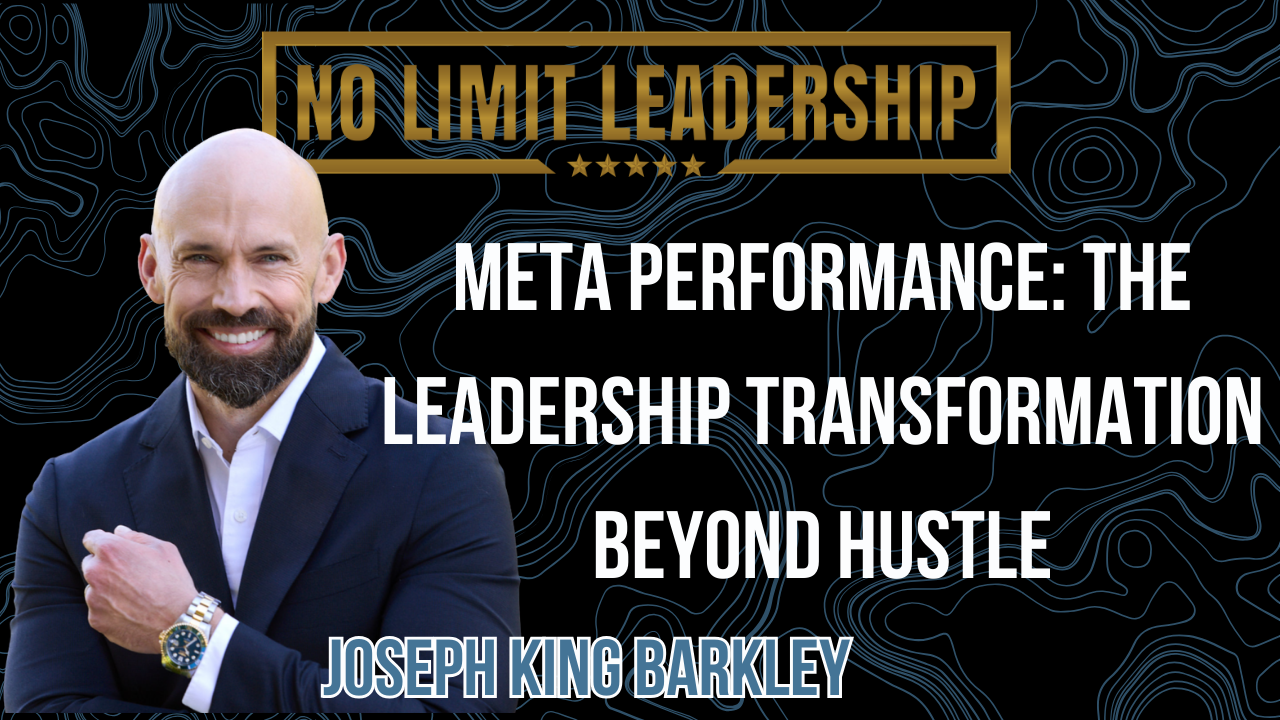
Joseph King Barkley
Most leaders listening to this are already high performers.
You work hard.
You are disciplined.
You set goals and hit them.
And yet, if you’re honest, something feels capped.
In this week’s episode of the No Limit Leadership podcast, I sat down with Joseph King Barkley, partner at Novus Global and President of the Meta Performance Institute, to explore why high performance eventually plateaus and what it actually takes to create lasting transformation.
High performance produces results.
But it produces them linearly.
Meta Performance changes the equation entirely.
Check out the whole episode:
#107 Meta Performance: The Leadership Transformation Beyond Hustle w/ Joseph King Barkley
Lead Yourself
Joseph explains that most leaders operate from a Do–Have–Be model:
Do more.
Achieve more.
Then finally feel confident, fulfilled, or secure.
This works, to a point. But it ties your identity to outcomes. Every setback feels personal. Every win must be repeated to stay worthy.
This is why high performance creates incremental gains, not transformation.
Meta Performance flips the model to Be–Do–Have.
Instead of starting with action, you start with identity.
Who must I be to create the life, leadership, and results I want?
When being shifts first, behavior follows naturally. Decision-making sharpens. Resilience increases. Growth accelerates. What once required force now compounds through alignment.
Joseph offers a deceptively simple question that changes everything:
“Who am I being right now, and who am I committed to being?”
That question moves leadership out of effort and into identity.
Action Steps:
Define the leader you are committed to being, independent of outcomes.
When pressure or resistance shows up, ask who you are being in that moment.
Choose one action today that aligns with identity, not comfort.
Lead Others
One of the most underutilized tools in leadership is feedback. Not feedback as criticism, but feedback as a mirror.
Leaders who grow exponentially invite feedback about where they might be getting in their own way. They are willing to create a gap between who they are today and who they are committed to becoming, because that gap is where growth lives.
Joseph is very clear that great feedback does not happen accidentally.
Leaders must invite it intentionally and create safety by naming their commitment to growth and explicitly asking for truth, even when it is uncomfortable. He models this by telling people he will not be offended and that the feedback will not hurt his feelings.
This permission matters because without it, most people self-edit. They protect relationships instead of telling the truth.
Quality feedback only emerges when the leader demonstrates they value growth more than comfort.
This is why I encourage anyone who is truly dedicated to exploring what they are capable of to get a Novus Global Coach. As Joseph put it, it is almost impossible to do surgery on yourself.
Action Steps:
Clearly articulate who you are committed to being as a leader.
Ask one trusted person where you might be missing the mark.
Treat feedback as fuel for development, not a threat to identity.
Becoming a No Limit Leader
High performance asks, What do I need to do to be the best?
Meta Performance asks, What am I capable of?
One creates linear progress.
The other creates transformation.
If you are disciplined, successful, and still feel capped, this conversation will challenge how you think about growth, leadership, and what is actually possible.
No Limit Leadership is not about pushing harder.
It is about becoming the kind of leader who empowers and inspires others to chase their version of greatness.
If you are ready to explore what your Meta Performance vision might be, you can apply for a free vision session here:
https://www.nolimitleaders.com/vision
If you are interested in being trained as a Meta Performance Coach, learn more through the Meta Performance Institute here:
https://www.mp.institute/contact
"Challenge Limits. Develop Leaders. Fuel Greatness."
-Sean Patton

You Don’t Need Permission to Lead This Way
“I stopped chasing balance. I started designing my life with intentionality.”
Danilda Polanco
Most people don’t struggle because they lack talent, discipline, or opportunity.
They struggle because they’re living inside beliefs they never chose.
Beliefs about who they are allowed to be.
Beliefs about how leaders are supposed to act.
Beliefs about what is realistic given their role, background, or season of life.
Danilda Polanco never waited for permission.
Born and raised in the Dominican Republic, Danilda moved to the U.S. at nineteen with no English, no safety net, and no guarantees. She became an architect, raised two young children, and built a design-build company in one of the most male-dominated industries there is.
This episode is not about architecture.
It is about identity, leadership, and the courage to build a life on your own terms.
#106: From Immigrant to 7-Figure Solopreneur w/ Danilda Polanco
Lead Yourself
Clarity comes when you stop accepting inherited beliefs and start testing them.
One of Danilda’s biggest breakthroughs came when she realized that many of the limits she believed in were never facts. They were stories. Stories about what was possible for an immigrant. A mother. A woman in construction.
Once she began questioning those beliefs instead of obeying them, her confidence and momentum changed. Not because her circumstances shifted, but because her internal story did.
Self-leadership starts with awareness. When you challenge the beliefs shaping your decisions, you create space for new thinking and new action. The moment you rewrite the story, your behavior follows.
Action Steps:
Identify one belief you currently hold about your limits, role, or responsibilities.
Ask yourself: How could the opposite be true?
If you believed this new story, how would your thinking change?
What actions would you take differently starting this week?
Lead Others
People don’t follow personas. They follow grounded, confident, self-actualized leaders.
Danilda was told repeatedly, even by other professional women, that to be taken seriously in construction she needed to lead “like a man.” Be harder. More aggressive. More dominant. More alpha.
She tried it. And it failed.
What worked was stepping fully into who she actually is. Calm. Prepared. Confident. Clear. Compassionate. Unapologetic.
That authenticity reshaped how she leads her subcontractors and crews. Instead of treating them as hired help brought in to execute tasks, Danilda treats them as partnered creatives. Builders. Craftspeople. Professionals helping bring a shared vision to life.
She collaborates with them. Respects their expertise. Invites ownership. And in doing so, she creates pride, accountability, and commitment far beyond what command-and-control leadership ever could.
People don’t give their best work to leaders who see them as replaceable labor.
They give it to leaders who treat them as trusted partners building something meaningful together.
Action Steps:
Examine how you currently view the people who execute the work around you.
Ask yourself where you may be managing “resources” instead of leading people.
Look for one opportunity this week to invite collaboration instead of issuing direction.
Pay attention to how trust, engagement, and ownership change when people feel like partners.
Becoming a No Limit Leader
Danilda said it best:
“You don’t need permission to create something extraordinary.”
No Limit Leaders do not wait for approval.
They do not try to fit into systems that were never designed for them.
They do not apologize for wanting more.
They lead themselves first.
They lead others through authenticity and collaboration.
And through that alignment, they give others permission to do the same.
Leadership is not a role you step into.
It is a life you design.
The question is simple:
Are you building by default, or by design?
Follow Danilda on IG: https://www.instagram.com/dope.arch/
"Challenge Limits. Develop Leaders. Fuel Greatness."
-Sean Patton
Executive Coach | Keynote Speaker | Host of the No Limit Leadership Podcast
Subscribe & Listen to latest podcast episode: Apple - Spotify - YouTube